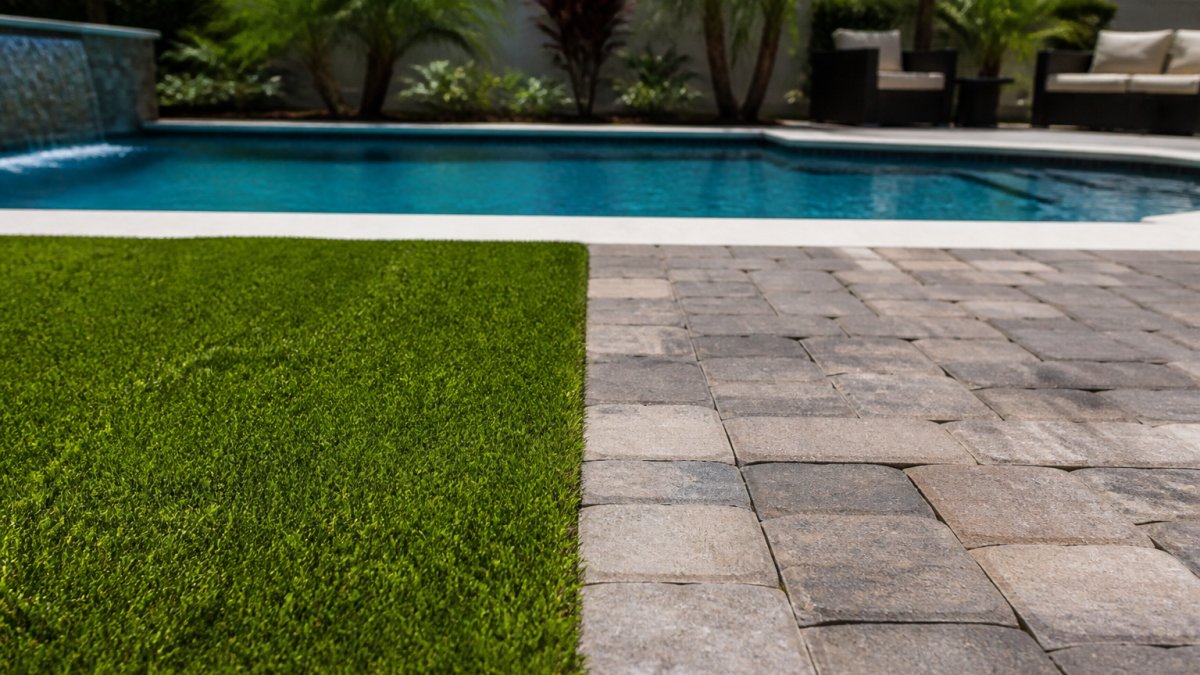
 comparison
Artificial Turf vs Pavers for Pool Deck Areas: 2026 Guide
Table of Contents
- Artificial Turf vs Pavers for Pool Deck Areas: The Short Answer
- Artificial Turf Around Pool Pros and Cons
- Pavers Around Swimming Pool Cost
- Heat, Traction, and Barefoot Comfort
- Artificial Grass Pool Deck Drainage and Base Preparation
- Best Artificial Turf for Pool Surrounds
- Maintenance, Upkeep, and Pool Chemistry Compatibility
- How to Choose for Your Pool and Climate
- Frequently Asked Questions
Last Updated: October 16, 2026
Artificial Turf vs Pavers for Pool Deck Areas: The Short Answer
If you want the shortest possible answer to the pool deck surface debate: pavers win on heat and longevity, artificial turf wins on barefoot comfort and slip resistance. For most pool owners in Northeast Florida, the right pick comes down to how you actually use the space around the water.
This guide from Bold Turf Co. breaks down the artificial turf vs pavers for pool deck areas decision using the real trade-offs we see on installation jobs: surface temperature, drainage, upfront cost, and how each material handles chlorine splash and heavy rain. The CDC guidance on pool water and surface contamination notes that debris and runoff around a pool directly affect how clean the water stays, which is why the surface you choose is not just a looks decision.
Here is the honest version before we get into details: neither surface is universally better. The winner depends on your climate, your budget, and whether you have kids or dogs using the pool surround daily.
Quick Comparison Table
| Factor | Artificial Turf | Pavers |
|---|---|---|
| Barefoot comfort | Soft, cushioned | Hard, unforgiving |
| Surface heat in sun | Can get hot without infill cooling | Very hot on light-colored stone |
| Slip resistance | High grip when dry | Slippery when wet or algae-coated |
| Drainage | Needs perforated backing and base | Excellent with proper joint spacing |
| Upfront cost | Moderate | Higher for travertine |
| Lifespan | 15-20 years | 30-50 years |
| Maintenance | Rinse, brush, occasional infill | Reseal, weed control, joint sand |
That table is the whole article in miniature. The rest explains why each row reads the way it does.
Artificial Turf Around Pool Pros and Cons
The biggest advantage of artificial turf around a pool is comfort. Synthetic grass gives you a soft, cushioned surface that stays cool enough for bare feet in most conditions, and it does not turn into a slick hazard the way wet stone can.
The pros:
- Cushioned underfoot, which matters for kids and older swimmers
- Strong traction when dry, reducing slip risk on the walk to the water
- No muddy patches where wet feet track in and out
- Year-round green appearance without watering or mowing
The cons are real, and we will not pretend otherwise:
- Surface heat in full sun can climb high enough to be uncomfortable
- Debris like leaves and sunscreen residue sits on top instead of washing away
- Poor drainage underneath causes standing water and odor
- Cheap turf with weak backing fails fast near chlorine splash zones
Pavers Around Swimming Pool Cost
Pavers around a swimming pool cost more upfront than turf in most projects, and the gap widens with material choice. According to AE Outdoor Living's pool deck material comparison, concrete pavers run roughly $16 to $28 per square foot, while travertine pavers land between $20 and $34 per square foot, with French pattern and tumbled edges pushing toward the top of that range.
Turf, by contrast, is cheaper to install. Pavers & Turf's turf versus paver breakdown reports turf installation costs ranging from $8 to $20 per square foot depending on quality, base preparation, and customization.
So the upfront math favors turf. But here is what most cost comparisons leave out: pavers last longer. High-quality turf can hold up 15 to 20 years with minimal upkeep, while maintained pavers can reach 30 to 50 years. Spread over decades, the price gap narrows considerably.
Lifecycle cost by area size
Broad affordability claims hide the real numbers. Here is how the two surfaces compare on a typical 400-square-foot pool surround, using the midpoints of the ranges above:
| Cost category | Artificial turf | Pavers |
|---|---|---|
| Installed cost (400 sq ft) | $5,600 ($14/sq ft) | $8,800 ($22/sq ft) |
| Annual cleaning and rinsing | $0 to $150 | $0 to $100 |
| Infill top-up or joint sand | $150 to $400 every 2 to 3 years | $100 to $300 every 2 to 3 years |
| Resealing or re-brushing | Not applicable | $400 to $900 every 3 to 5 years |
| Localized repair (per incident) | $300 to $800 per section | $150 to $500 per paver cluster |
| Full replacement year | Year 15 to 20 | Year 30 to 50 |
Over a long-term horizon, turf may require replacement, while pavers may need resealing, joint sand, and occasional spot repairs. The lifetime cost of pavers can sometimes be comparable to or below turf, especially if the pavers are installed over a stable base.
Repairability and replacement
This is the angle most cost articles skip.
Pavers are repaired by lifting the affected units, re-leveling the sand or base, and resetting. Matching dye lots on older pavers is the common frustration; a faded paver next to a new one reads as a patch.
For a current quote on your specific pool surround, request a free turf estimate rather than relying on national averages.
Heat, Traction, and Barefoot Comfort
Heat and traction are where these two surfaces diverge most sharply, and they pull in opposite directions. Pavers stay cooler underfoot than dark turf in direct sun, but they become slippery when wet or coated with algae. Turf stays grippy but can absorb and hold heat.
Why each surface gets hot
The mechanism matters more than the label. Pavers heat up through direct solar absorption, a light travertine or concrete paver reflects more sunlight and stays noticeably cooler than a dark charcoal paver, which can reach temperatures that are uncomfortable to stand on barefoot in midsummer.
Shade is the single biggest lever. A pool surround that gets afternoon shade from a screen enclosure, pergola, or mature tree will stay 20 to 30 degrees cooler at the surface than one in full sun, regardless of material.
Traction and slip resistance
Turf wins on dry traction. The fibers and infill give bare feet something to grip, and the surface does not turn slick the way wet stone can. Pavers win on wet traction only when they are textured and properly jointed, smooth travertine or polished concrete around a pool is a genuine slip hazard, especially with algae film. A common pattern is that paver decks near the water line develop a thin algae layer that is invisible until someone steps on it wet.
Barefoot comfort
Barefoot comfort breaks down like this:
- Turf: soft, springy, forgiving on joints and easy on kids' feet
- Pavers: firm and stable, but unforgiving on bare soles and hot enough to burn on a summer afternoon
Accessibility and mobility
For accessibility, pavers win clearly. Wheelchairs, walkers, and pool chairs roll smoothly across a flat paver surface. Turf's cushioning makes rolling harder, which is a genuine limitation for households with mobility needs. Transitions matter too: the edge where turf meets a paver border or a concrete pool coping is a common trip point if the two surfaces are not set flush. A beveled border or a flush-set paver band at the transition solves most of it.
Artificial Grass Pool Deck Drainage and Base Preparation
Drainage is the single most important installation detail for an artificial grass pool deck, and it is the step most cheap installers skip.
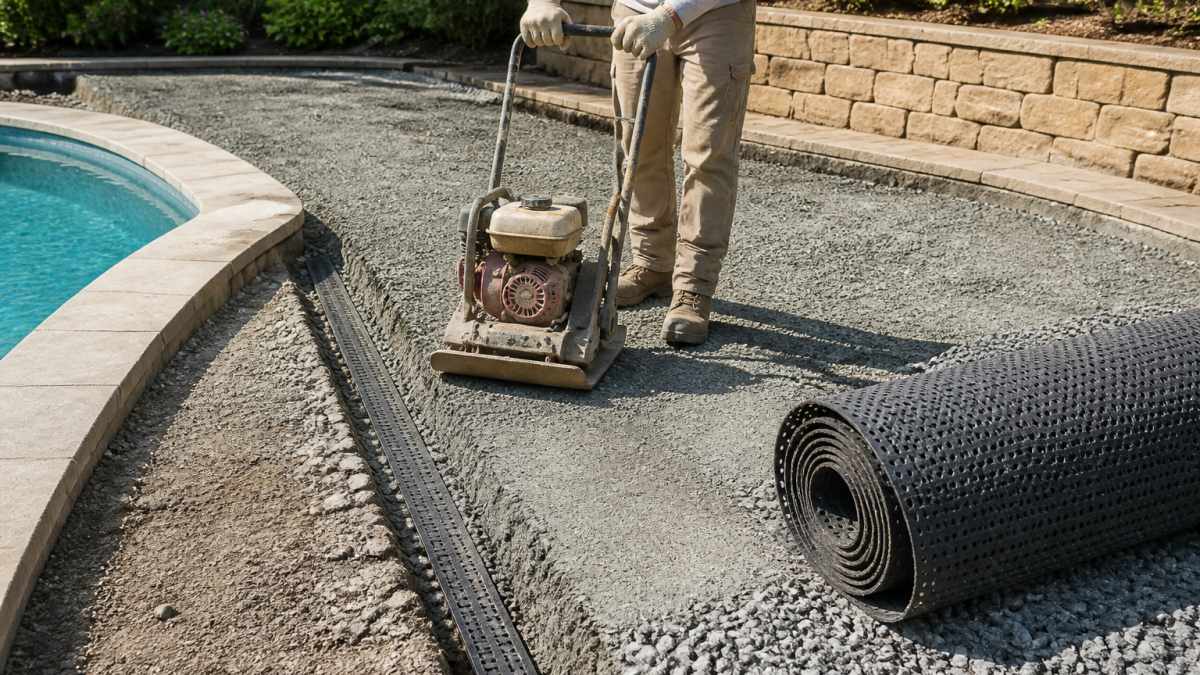
A proper build includes:
- Excavating 3 to 4 inches of existing soil
- Laying and compacting a crushed stone base
- Grading a slope away from the pool edge
- Installing a perforated backing so water passes through
- Adding a drainage channel at the low point
Pavers handle runoff differently. Their joint gaps and underlying sand bed let water drain naturally, which is why they rarely hold standing water. Turf can match that performance, but only when the base is built correctly. There is no shortcut here.
Best Artificial Turf for Pool Surrounds
The best artificial turf for pool surrounds uses polyethylene fibers, UV protection, and a pile height around 1.0 to 1.5 inches. That combination balances softness, durability, and heat management near water.
TurfTek USA's guide to choosing turf for pool areas recommends polyethylene-based turf paired with a well-designed drainage system, noting that softness and durability are the two qualities pool owners should weigh most.
What most guides miss is the fiber shape.
At Bold Turf Co., we install PFAS-free turf and manage each project from start to finish, so you are not chasing a call center when something needs adjusting.
Maintenance, Upkeep, and Pool Chemistry Compatibility
Maintenance is where turf's reputation as "low effort" needs a caveat. Turf needs no mowing, watering, or fertilizing, but it does need rinsing, brushing, and occasional infill top-ups, especially in a pool zone where sunscreen, sweat, and chlorine splash land constantly.
Pavers need resealing every few years, weed control in the joints, and periodic joint sand replacement. Neither surface is maintenance-free.
Pool chemistry compatibility is the angle almost nobody covers. Chlorine splash and saltwater systems both affect surrounding materials:
- Turf fibers and backing resist chlorine and salt well when the turf is quality-built
- Natural stone pavers can etch or discolor over years of chemical exposure
- Both surfaces should be rinsed after heavy chemical shocking
How to Choose for Your Pool and Climate
Choosing between turf and pavers comes down to four questions: how hot your summers get, who uses the pool, how much you want to spend upfront, and how much upkeep you will tolerate.
Use this decision framework:
| Your Priority | Choose |
|---|---|
| Barefoot comfort, kids, pets | Artificial turf |
| Lowest upfront cost | Artificial turf |
| Longest lifespan, lowest lifetime cost | Pavers |
| Wheelchair or walker access | Pavers |
| Coolest surface in full sun | Light pavers |
| Fastest install, no mowing | Artificial turf |
In a hot, humid climate with heavy summer rain, drainage design matters more than material choice. Get the base right and both surfaces perform well. Skip it and neither will.
If you are weighing artificial turf vs pavers for pool deck areas on your own property, the fastest path to a clear answer is a site assessment.
Frequently Asked Questions
What is the best surface for a pool deck?
There is no single best surface. Pavers stay cooler underfoot, resist standing water, and last 30-50 years with care, while artificial turf offers a softer, cushioned feel and a green look year-round. For a pool deck, many homeowners split the space: pavers on the walkway and coping, turf in lounging or play zones. That mix keeps barefoot comfort high and limits turf's heat and debris issues to areas where they matter least.
What are the pros and cons of artificial turf around a pool?
Pros: soft underfoot, no mud, no mowing, and a consistent green look. Cons: surface heat in direct sun, more debris and leaf cleanup than pavers, and a base that must drain well to prevent standing water. Turf fibers and infill can also collect sunscreen residue and pool splash-out. Most drawbacks are manageable with the right pile height, infill, and drainage design.
Which is cheaper, pavers or artificial turf?
Turf installation costs vary depending on quality, base preparation, and customization. Concrete and travertine pavers also have varying costs. High-quality turf can last 15-20 years with minimal upkeep, while maintained pavers can last 30-50 years. It's important to compare total cost over the full lifespan, not just the install price.
Does artificial turf get hot around a pool?
Yes. In direct sunlight, artificial turf can reach surface temperatures well above air temperature, and bare feet feel it. You can reduce this with lighter-colored turf, a silica-based infill, shade from umbrellas or plantings, and by watering the surface briefly before guests arrive. Pavers also heat up, but they cool faster once shaded and do not trap heat in fibers the same way.
Can artificial turf drain properly around a swimming pool?
It can, if the base is built for it. A proper install uses a compacted crushed stone base, a perforated turf backing, and a slope that moves water away from the pool. That combination handles splash-out, rain, and rinse water without standing water. Skipping the base work is the most common reason turf around a pool stays soggy or develops odors.
Your pool surround should be the most comfortable, safest part of your yard, not a surface you avoid in bare feet. Bold Turf Co. installs PFAS-free artificial turf and hardscapes across Northeast Florida, with 0% financing options, direct owner involvement from start to finish, and a local team that stands behind its work. Get started with Bold Turf Co. and request your free turf estimate today.