 ultimate-guide
Artificial Turf Installation Timeline: What to Expect
Table of Contents
- How Long Does Artificial Turf Installation Take? A Realistic Breakdown
- Residential Yards vs. Commercial Fields: Two Very Different Timelines
- Artificial Turf Installation Process Steps, Phase by Phase
- Factors Affecting Artificial Grass Installation Time
- How Long After Turf Installation Can You Walk On It?
- Permits, HOA Approvals, and Seasonal Demand: Timelines Competitors Skip
- Your Pre-Installation Checklist Before the Crew Arrives
- Conclusion: Planning Your Project With Confidence
- Frequently Asked Questions
Last Updated: September 23, 2026
How Long Does Artificial Turf Installation Take? A Realistic Breakdown
Most residential artificial turf installation projects wrap up in two to five days once materials are on site. That number surprises homeowners who've heard horror stories about week-long disruptions. The artificial turf installation timeline expectations you should actually plan around depend far more on site conditions, permitting, and crew scheduling than on the physical act of rolling out synthetic grass.
Residential Yards vs. Commercial Fields: Two Very Different Timelines
Residential installation typically takes two to five days. Commercial field projects can stretch to several weeks or longer because of project scope, square footage, and permitting requirements.
The gap comes down to three things:
- Square footage: A typical backyard runs a few hundred to a couple thousand square feet. A commercial field can exceed 80,000 square feet.
- Sub-base depth: Residential lawns often need a shallower base. Commercial fields require engineered sub-base layers for drainage, shock absorption, and load-bearing.
- Site inspection and engineering: Commercial projects frequently need formal site inspections, drainage system design, and sometimes structural engineering sign-off.
Artificial Turf Installation Process Steps, Phase by Phase
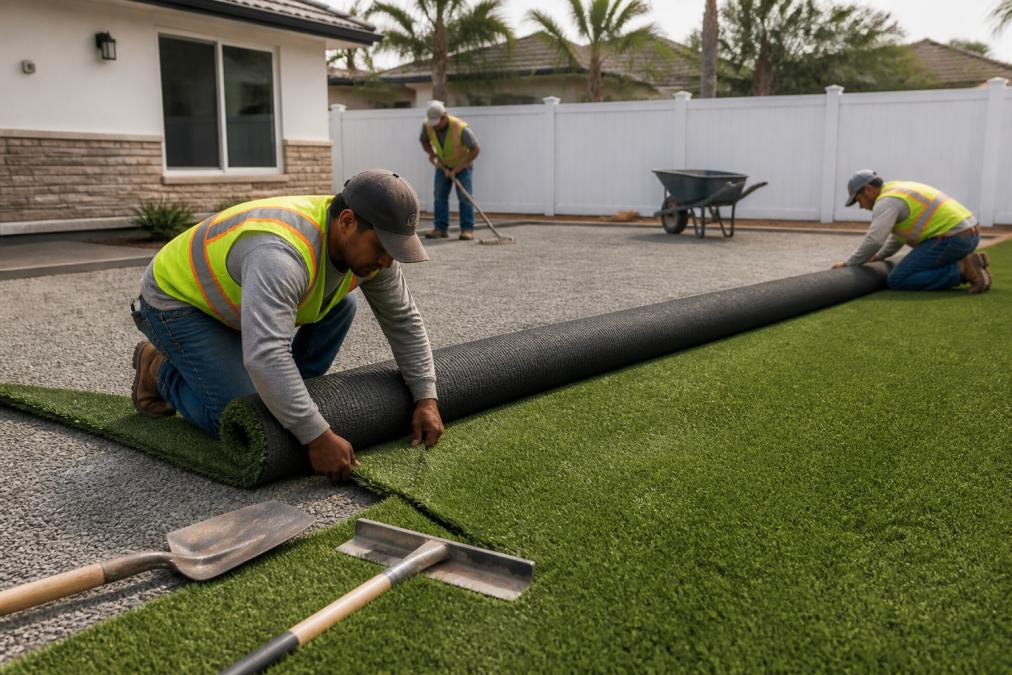
Breaking the project into phases makes the schedule predictable. Here's how a standard residential installation moves from start to finish.
Phase 1: Site Inspection and Excavation
Site inspection and excavation usually take one to two days. The crew measures the area, checks drainage, and removes the existing surface.
Phase 2: Base Prep, Turf Delivery, and Laying
Base prep is the most time-intensive phase, often taking one to three days on its own. Crews lay and compact crushed stone or a similar base material, then check the grade.
Phase 3: Seaming, Trimming, and Infill Application
Seaming, trimming, and infill application typically finish within a day. Crews cut and join panels, trim edges against borders and hardscapes, then spread infill to weight the turf and support the blades.
| Phase | Typical Duration | What Drives the Time |
|---|---|---|
| Site inspection and excavation | 1-2 days | Soil conditions, roots, old irrigation |
| Base prep and laying | 1-3 days | Base depth, drainage, turf delivery |
| Seaming, trimming, infill | ~1 day | Seam count, edge complexity, infill type |
Factors Affecting Artificial Grass Installation Time
The factors affecting artificial grass installation time fall into two buckets: what's on your property, and what's happening around it. The trick is knowing which factors add hours versus which add days, because most guides lump them together and leave you unable to predict your own schedule.
On-Property Factors (Hours to Days)
- Project complexity: A simple rectangle is faster than a multi-zone yard with curves, planters, and a putting green. Each additional zone typically adds a half-day of layout, cutting, and seaming.
- Drainage system needs: Poor natural drainage means added base work and possibly a French drain or channel drain.
- Turf type and pile height: Taller pile and heavier face weights are harder to handle and seam.
- Ground stabilization: Soft or uneven ground may need stabilization before base prep.
- Access and staging: A narrow side gate or a backyard with no equipment access means crews hand-carry base material and turf rolls, which can double the labor hours for the same square footage.
Off-Property Factors (Days to Weeks)
- Contractor scheduling: Good crews book out, especially in peak season. A two-week lead time in February can become a six-week lead time in May.
- Materials availability and lead time: Turf type and infill may need to be ordered. This is the single most underestimated factor, see the supply chain note below.
- Weather conditions: Rain halts excavation and base compaction. A single washed-out base can set you back days because the sub-base has to dry and be re-compacted.
- Permitting and HOA review: Administrative approvals can run longer than the physical install itself (covered in detail further down).
The Factor Most Guides Get Wrong: Product Availability vs. Installation Time
These are two separate clocks, and conflating them is why homeowners get blindsided. Installation time is the crew's calendar. Product availability is the manufacturer's and distributor's calendar.
How Long After Turf Installation Can You Walk On It?
You can usually walk on artificial turf immediately after installation. Light foot traffic is fine right away because the base is already compacted and the turf is secured. But "walkable" and "fully settled" are not the same thing, and the gap between them is where most post-installation disappointment lives.
The Settling Timeline, Broken Down
- Day 0 (installation day): Light foot traffic is fine. Keep heavy furniture, grills, and vehicles off the surface.
- Days 1-3: Infill continues to distribute and settle into the pile. This is when seams finish curing and the surface begins to feel uniform underfoot.
- Days 3-7: Most installers consider the surface ready for normal residential use, including pets and kids, once infill has had time to work into the base of the blades.
- Weeks 2-4: The turf fully relaxes and the pile stands up consistently. Any minor wrinkles from shipping compression disappear on their own in normal heat.
Why Infill Settling Matters More Than People Think
Infill is what weights the turf down, holds the blades upright, and gives the surface its finished feel. Right after installation, infill sits on top of the pile. Foot traffic and time work it down to the base where it belongs. If you put heavy furniture or a playset on the surface on day one, you can create low spots where infill never distributes evenly, and those show up as visible depressions months later.
Heat, Curing, and the First Hot Week
Synthetic turf expands and contracts with temperature. On a hot, sunny day, a newly installed surface can soften slightly and the pile can relax. This is normal and is actually part of the curing process. The practical takeaway: avoid dragging heavy items across the surface during the first hot week, because the backing is more pliable and seams are more vulnerable to stress.
Pet and Kid Considerations
Pets and kids can typically use the surface within a few days, but there are two caveats. First, give seams the full settling window before heavy running and pivoting, since sharp direction changes stress the seam tape. Second, if you have a dog that digs, watch the surface for the first couple of weeks, a freshly settled infill layer is easier to displace than a fully cured one.
Permits, HOA Approvals, and Seasonal Demand: Timelines Competitors Skip
This is the part almost every timeline guide leaves out, and it's the part that most often blows a schedule.
Your Pre-Installation Checklist Before the Crew Arrives
A little prep on your end keeps the crew moving and protects your timeline. Run through this before day one:
- Clear the work area of furniture, toys, grills, and pet waste stations
- Mark and protect irrigation heads, sprinkler lines, and lighting
- Confirm HOA approval is in hand if required
- Verify permits are secured for any drainage or grading work
- Confirm the turf type and infill are in stock with your installer
- Arrange pet and child access so they're out of the work zone
- Confirm the delivery window for the turf roll and base material
- Ask your installer for a written phase-by-phase schedule
Conclusion: Planning Your Project With Confidence
The honest answer to "how long does artificial turf installation take" is that the physical work is the easy part. Permits, HOA sign-off, materials lead time, and weather are what actually move your completion date. Plan for those and the rest falls into place.
Frequently Asked Questions
How long does it take to install artificial turf for a residential yard?
Most residential artificial turf installation projects take two to five days from excavation to final infill, depending on square footage and site conditions. Permitting and HOA approvals, material lead times, and weather can add days or even weeks before the crew breaks ground, so plan for the full timeline, not just the on-site work.
What factors affect artificial grass installation time the most?
The biggest factors affecting artificial grass installation time are total square footage, site preparation needs, and weather. Removing existing grass, correcting grading, and installing a proper drainage system take longer on uneven or poorly draining lots. Material lead times and contractor scheduling also matter, especially during spring and summer when demand peaks. Commercial fields with sub-base engineering, multiple seams, and line markings can stretch from weeks to months compared to a straightforward residential lawn.
How long after turf installation can you walk on it?
You can typically walk on artificial turf immediately after the crew finishes infill application and final brushing. For heavy use like pets running or kids playing, waiting 24 hours lets the infill settle evenly.
Does weather delay artificial turf installation?
Yes. Rain is the most common delay because excavation and base compaction require dry conditions. Standing water in an open sub-base can push a project back by several days while the site dries. Extreme heat can also slow crews working with adhesives and infill. In Northeast Florida, afternoon thunderstorms during summer months are a real scheduling factor, which is why reputable installers build buffer days into the timeline rather than promising a fixed completion date.