 ultimate-guide
Commercial Artificial Turf for Pet Facilities: 2026 Guide
Table of Contents
- What Commercial Artificial Turf for Pet Facilities Must Handle
- Artificial Grass for Dog Daycare, Kennels, and Boarding Facilities
- Pet Turf Drainage and Odor Control: Design and Performance
- Commercial Dog Turf Installation: Specs, Base, and Project Planning
- Pet Turf Maintenance and Cleaning Protocols
- Lifecycle Cost, Durability, and Return on Investment
- Choosing a Commercial Artificial Turf Partner
- Frequently Asked Questions
Last Updated: October 20, 2026
What Commercial Artificial Turf for Pet Facilities Must Handle
Commercial artificial turf for pet facilities is a synthetic grass system engineered for continuous animal traffic, urine exposure, and repeated cleaning rather than occasional backyard use. At Bold Turf Co., we install these systems across Northeast Florida, and the difference between turf that survives a kennel season and turf that fails by month six comes down to four things: drainage rate, fiber resilience, backing construction, and how the surface handles waste.
A residential-grade product will not hold up here. Pet facilities concentrate more animals per square meter than any home lawn ever will, and the failure points show up fast.
Here is what the surface actually has to survive:
- Concentrated urine loads from dozens of animals using the same relief area daily
- Digging and scratching from bored or anxious dogs
- Repeated rinsing and sanitizing without fiber breakdown
- Heavy foot traffic from staff, animals, and equipment
- Standing water if drainage is undersized
Artificial Grass for Dog Daycare, Kennels, and Boarding Facilities
Artificial grass for dog daycare, kennels, and boarding facilities differs from residential pet turf in three measurable ways: pile height, fiber shape, and backing permeability.
Kennels present a different problem entirely. Dogs in runs pace, scratch at edges, and mark the same corners repeatedly.
For facility managers planning capacity, the practical rule is to size relief areas by peak animal count, not average.
Pet Turf Drainage and Odor Control: Design and Performance
Pet turf drainage and odor control is a system design problem, not a product feature.
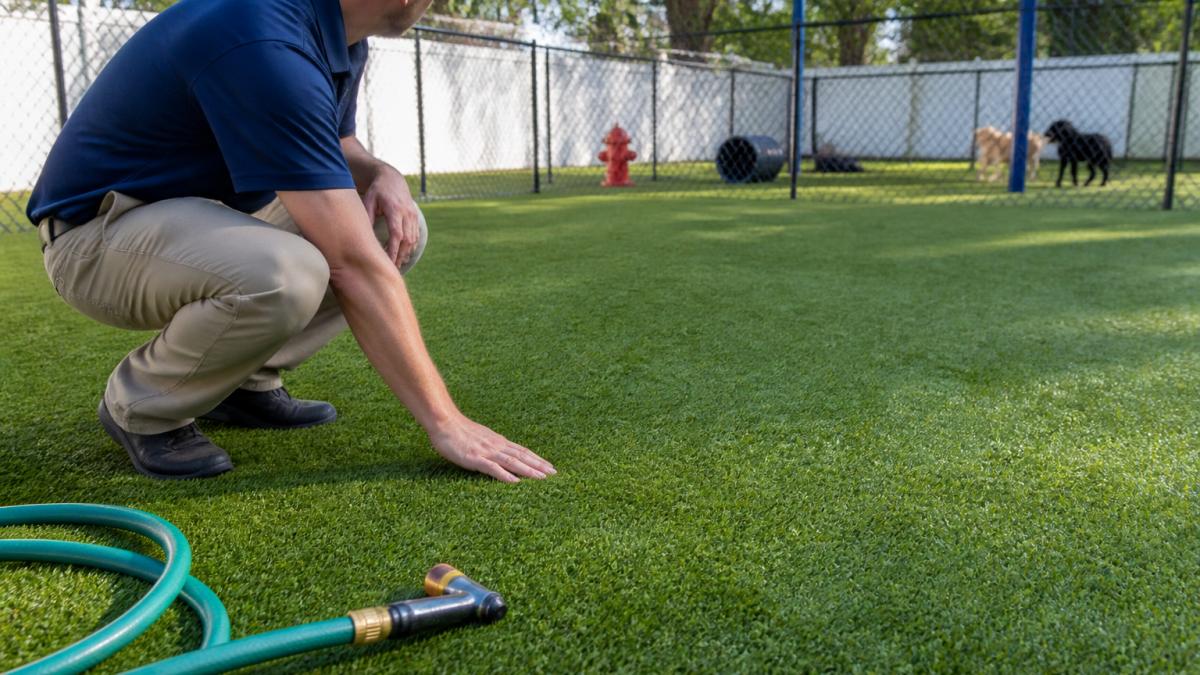
The performance test we run before signing off on any commercial pet installation is simple: saturate a test section, then watch how long surface water takes to disappear.
Odor control comes from three layers working together:
| Layer | Function | Failure Symptom |
|---|---|---|
| Turf backing | Passes liquid, blocks solids | Surface puddling |
| Drainage layer | Moves water laterally to outlets | Soggy patches after rain |
| Compacted base | Directs water away, supports infill | Settling, low spots, persistent smell |
Antimicrobial infill and bacteria-resistant additives help, but they are not a substitute for drainage. We treat them as a supporting measure, never the primary defense.
Commercial Dog Turf Installation: Specs, Base, and Project Planning
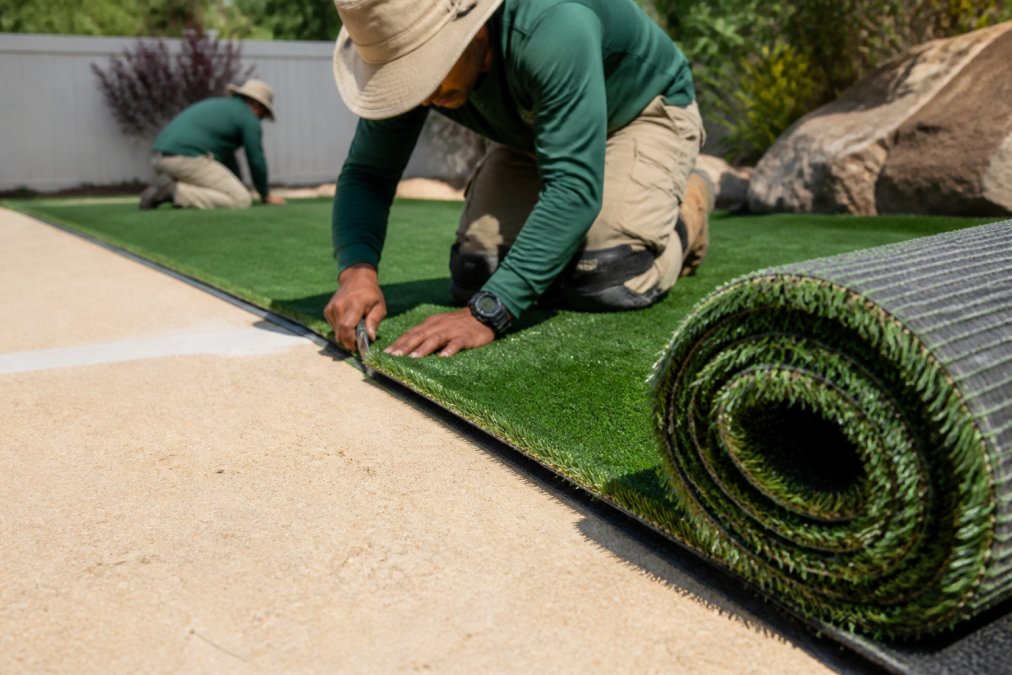
Commercial dog turf installation follows a sequence: excavation, base preparation, compaction, drainage integration, turf placement, seaming, infill, and rinse-down testing.
The bigger gap in most facility projects is not the sequence, it is the specification. Most quotes describe the turf in marketing language ("premium," "heavy-duty," "pet-safe") and leave the base and drainage layer undocumented. A facility manager cannot compare bids that way.
Material specifications to require in writing
- Pile height: shorter pile (roughly 3/4 inch to 1 inch) for high-traffic runs and relief lanes where matting and cleaning speed matter; slightly taller (about 1 inch to 1-1/4 inch) for play yards where comfort and appearance carry more weight. Pile height should be matched to use zone, not chosen once for the whole site.
- Face weight: the mass of fiber per square yard. Higher face weight generally means denser, more durable turf, but weight without resilient fiber shape is wasted money. Ask for face weight and fiber shape together.
- Fiber shape: textured, slit-film, or multi-filament fibers that spring back under paw traffic. Straight monofilament in a short pile mats quickly in kennel runs.
- Backing: permeable, multi-layer backing with a documented flow rate, not a verbal claim. Ask for the flow rate in inches per hour and the test method used to establish it.
- Infill: antimicrobial, non-toxic, and sized to the fiber and pile height. Infill depth should be specified, because too little infill exposes backing and too much traps moisture.
Base and drainage specifications
- Base depth: engineered aggregate depth matched to local soil, rainfall, and expected urine load. A base sized for a backyard will not carry a 40-dog daycare.
- Compaction: documented compaction in lifts, with density testing. An uncompacted base settles unevenly and creates the low spots where water and odor collect.
- Slope: a graded fall toward drainage outlets so surface water moves rather than ponds. Slope should be verified after compaction, not assumed from the plan.
- Drainage layer: a lateral drainage layer that moves water to outlets, sized to the peak flow the facility will actually produce.
Project planning around an operating facility
Facilities cannot always shut down. We phase installations by zone so a kennel or daycare keeps operating while sections are rebuilt, and we build the schedule around the facility's peak booking periods rather than ours. Phasing has a cost, temporary fencing, temporary relief areas, and more mobilization, so it should be planned into the quote, not discovered mid-project.
Pet Turf Maintenance and Cleaning Protocols
Pet turf maintenance and cleaning comes down to a daily, weekly, and periodic rhythm.
- Daily: pick up solid waste immediately, rinse relief areas, spot-check high-use corners
- Weekly: deep rinse with clean water, brush fibers upright, inspect seams and edges
- Monthly: check infill depth, top off where needed, inspect drainage outlets for blockage
- Seasonally: professional deep clean, full drainage performance check
Wastewater handling deserves attention. Rinse water should flow to a drain or designated area, not pool on adjacent surfaces or run into storm systems without consideration of local requirements.
Easy-to-clean surfaces are a design outcome, not a marketing claim. Short pile, permeable backing, and correct infill make cleaning fast.
Lifecycle Cost, Durability, and Return on Investment
Lifecycle cost is where the real comparison happens, and it is the angle most facility buyers skip. A commercial pet turf system is a multi-year asset, and the number that matters is cost per year of service, not cost per square foot at install.
The reason lifecycle cost gets skipped is that it is hard to compare. A turf quote is a single number; natural grass is a dozen small numbers spread across years.
Cost categories to capture for each option
- Upfront installation: excavation, base, drainage, turf, infill, seaming, and testing. For natural grass, this includes soil prep, sod or seed, and irrigation.
- Water: irrigation volume for natural grass, measured against local water rates. Turf rinsing uses water too, so count it on both sides.
- Labor: mowing, edging, fertilizing, aerating, and reseeding for grass; waste pickup, rinsing, brushing, and periodic deep cleaning for turf.
- Repairs: patching worn grass, reseeding bare spots, and repairing irrigation versus seam repair, infill top-off, and drainage clearing on turf.
- Replacement cycle: natural grass in a high-traffic dog yard typically needs significant renovation far more often than a properly installed turf system needs resurfacing. The replacement interval is the single biggest driver of lifecycle cost.
- Downtime: a dog yard that is muddy, closed, or under renovation is a cost even when no invoice arrives. Turf's all-weather usability has real operational value.
Durability drivers we track
- Wear resistance under concentrated traffic patterns
- UV stability for facilities with full sun exposure
- Seam integrity at high-stress junctions
- Infill retention over years of rinsing
- Drainage performance over time as fines migrate into the base
A system that drains well in year one and poorly in year five has a hidden lifecycle cost. Ask how the drainage layer is protected from fines and how performance will be re-tested after installation.
How to build the comparison
Put both options on a spreadsheet with the same time horizon, typically the expected service life of the turf system. Total every cost category above for each option, divide by years of service, and compare cost per year.
Facilities that compare quotes on install price alone often pay twice: once for the cheap system, and again to replace it early.
We do not publish pricing figures here because every facility differs by area, drainage complexity, and access.
Choosing a Commercial Artificial Turf Partner
Choosing a commercial artificial turf partner is a procurement decision, and it should be documented like one.
- Can you document drainage flow rate and base depth in writing?
- What pile height and fiber shape do you recommend for our traffic pattern, and why?
- Are your materials PFAS-free, and can you provide documentation?
- How will you phase installation to keep our facility operating?
- What does your cleaning and maintenance handoff include?
- Who manages the project day to day, and can we reach them directly?
That last question separates local installers from national franchises. We are licensed, family-owned, and have completed over 100 local jobs since 2020, using PFAS-free materials with 0% financing available.
U.S. Environmental Protection Agency research on PFAS is worth reading before you sign anything, because material safety claims should be verifiable rather than assumed.
Pet facilities face a real challenge: a surface that has to survive urine, digging, and daily cleaning while still looking presentable to clients.
Frequently Asked Questions
What type of artificial turf is best for pets?
Look for pet-specific synthetic grass with short pile height (around 1 to 1.5 inches), a dense thatch layer, and a permeable backing so urine drains instead of pooling. Non-toxic, PFAS-free materials matter for safety, and antimicrobial infill helps with bacteria resistance. For commercial artificial turf in kennels, dog daycare, and boarding facilities, prioritize wear resistance and surface drainage over appearance. Ask for material specs in writing and confirm the turf is rated for high-traffic areas before you sign a quote.
How do you control urine odor on artificial turf?
Odor control starts with drainage design, not chemicals. A properly compacted base, permeable backing, and graded surface drainage move urine off the surface fast. Pair that with routine rinsing, enzyme-based cleaners that break down uric acid, and scheduled waste removal. In pet turf drainage and odor control planning, install a slight slope toward drains and avoid low spots where liquid sits. Facilities that rinse daily and deep-clean monthly report far fewer odor complaints than those relying on deodorizer sprays alone.
How often should artificial turf in a dog facility be cleaned?
Daily waste removal and rinsing should be standard in any pet play area or dog run. Deep cleaning with an enzyme cleaner typically happens weekly to monthly depending on traffic and capacity. High-use dog daycare and boarding facilities may need disinfection several times a week. Build a written cleaning schedule into pet turf maintenance and cleaning protocols, log each session, and adjust frequency during peak season. Surface sanitation is easier to maintain when drainage is working correctly.
How long does commercial pet turf last?
Most commercial-grade pet turf lasts roughly 10 to 15 years when installed over a properly prepared base and maintained on schedule. Lifespan depends on fiber quality, infill choice, traffic volume, and whether drainage is functioning. Heavy-use dog parks and kennels sit at the lower end; lower-traffic veterinary clinics and pet relief areas can stretch longer. Keep installation records and cleaning logs, because documented maintenance supports warranty claims and helps you plan replacement budgets.
What features should commercial pet facility turf have?
Prioritize permeability and surface drainage, wear resistance for heavy use, non-toxic and PFAS-free materials, antimicrobial or bacteria-resistant backing, and a pile height suited to dogs rather than landscaping looks. Confirm the turf is rated for commercial applications and comes with a warranty that covers pet facility use. Ask about infill options, base preparation specs, and cleaning requirements. A supplier who can document performance testing for drainage and durability is a safer choice than one quoting on price alone.
How much does artificial pet turf cost?
Pricing depends on square footage, turf grade, infill, base preparation, drainage work, and site access, so no single figure fits every facility. Commercial projects with drainage systems and heavy-use specs cost more per square foot than simple residential installs. Request an itemized quote that separates turf material, base work, drainage, and installation labor. Compare lifecycle cost, not just upfront price, since a cheaper surface that fails early costs more over ten years.