 how-to
How to Stop Dogs Digging Artificial Turf: 7 Fixes
Table of Contents
- Why Dogs Dig Up Artificial Turf (and Why It Gets Worse)
- Physical Barrier Installation Techniques That Actually Work
- Behavioral Modification for Dogs That Dig on Turf
- How to Repair Artificial Turf Dog Damage
- Best Pet-Friendly Artificial Turf: What to Look For
- How to Clean Pet Urine from Artificial Turf
- Frequently Asked Questions
Last Updated: October 7, 2026
Why Dogs Dig Up Artificial Turf (and Why It Gets Worse)
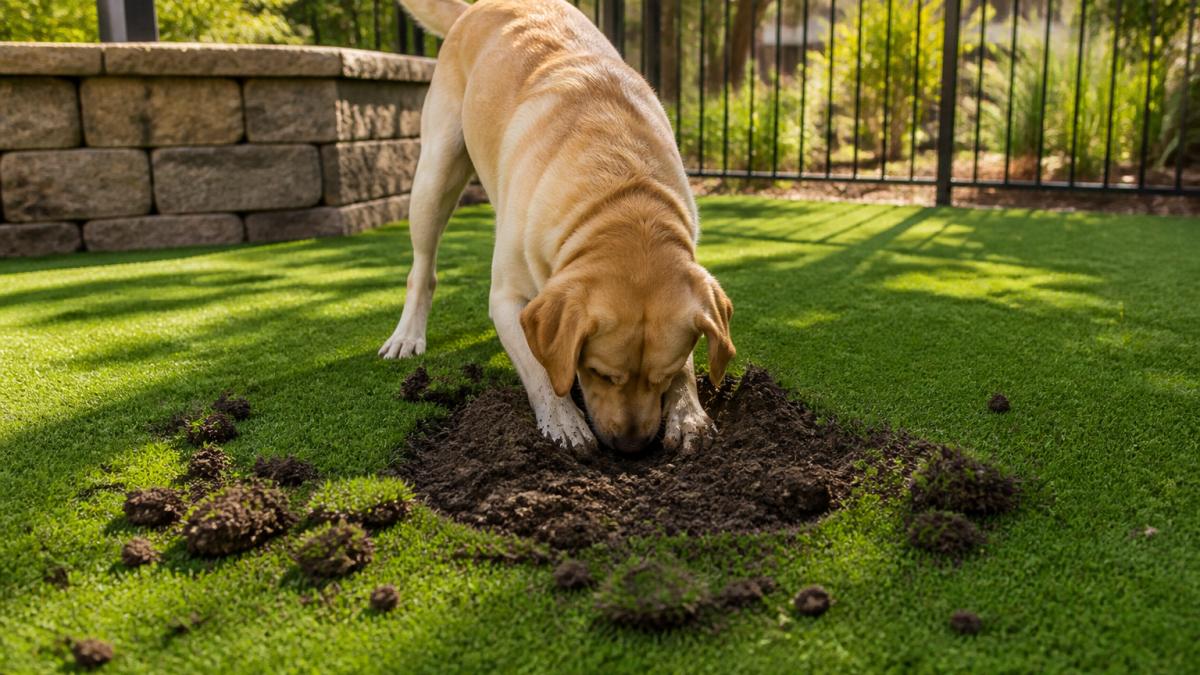
To stop dogs digging artificial turf, you have to understand why they do it: scent trails, boredom, and prey drive. The difference is that turf hides the damage until it becomes expensive. At Bold Turf Co., we see this constantly in Northeast Florida yards, and it rarely fixes itself.
Scent Trails, Boredom, and Prey Drive
Three triggers explain almost every case we inspect.
- Scent trails. Other animals, food smells, or urine soak into the infill and backing. Your dog digs to reach the source.
- Boredom. A dog left alone in a yard with nothing to do will invent a job. Digging is a self-rewarding one.
- Prey drive. Lizards, moles, and insects move under the surface. The turf springs back slightly, which mimics live movement and triggers a chase.
How Digging Damages Turf: Infill Displacement, Lifted Seams, Rippled Backing
Turf damage from digging follows a predictable pattern: claws fling silica sand and rubber infill out of the pile, the backing stretches, then seams separate.
Once infill is gone, the fibers have no weight holding them upright. The blades flatten, and the area looks bald. Lifted seams and rippled backing are the expensive stage, because water gets underneath and the base can shift.
Physical Barrier Installation Techniques That Actually Work
Physical barriers stop dogs digging at the source by making the surface unrewarding. This is the most reliable fix we install, even for determined diggers.
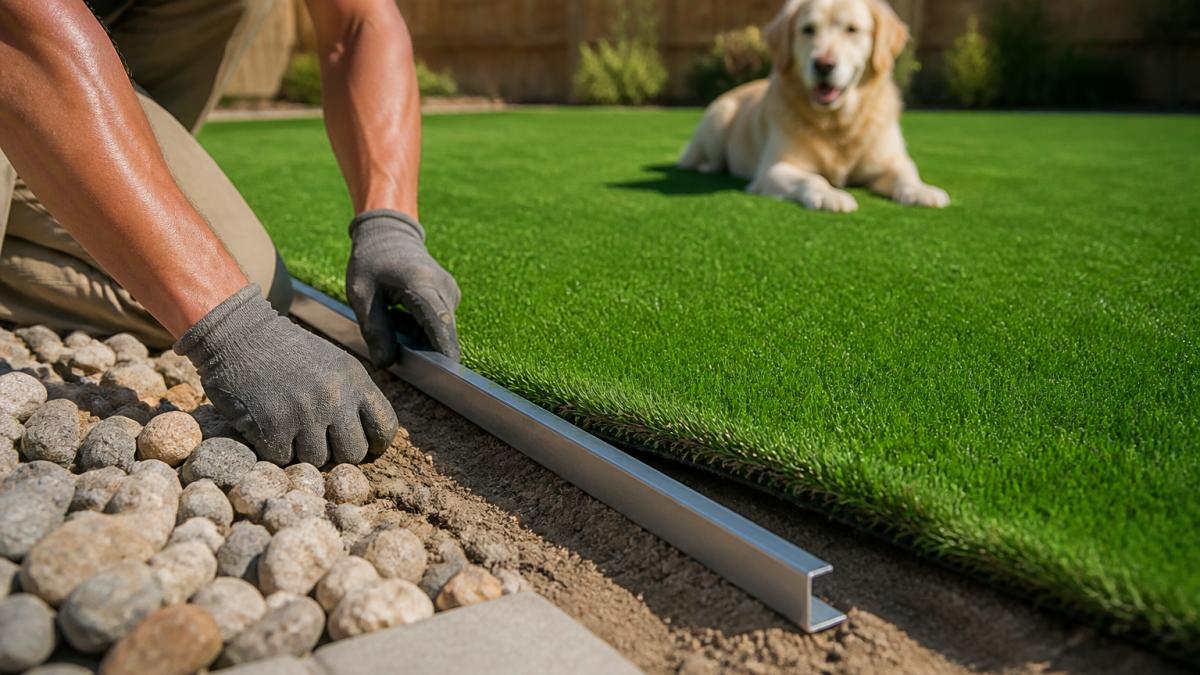
Buried Mesh and L-Shaped Edge Restraints
Buried mesh is a heavy-duty grid laid under the turf and base.
L-shaped edge restraints lock the turf perimeter so seams cannot lift: the vertical leg holds the turf edge, the horizontal leg anchors into the base.
The key detail most installers miss: mesh must sit below the base layer, not directly under the backing.
Here is what to specify when you buy or install each component:
| Component | What to specify | Where it goes | Failure mode if done wrong |
|---|---|---|---|
| Buried mesh | Rigid welded or woven grid with roughly 1/2-inch to 1-inch apertures; galvanized or coated steel resists rust in humid yards | Below the compacted base, spanning the dig zone | Mesh laid on top of the base lets claws hook it and pulls the turf into ripples |
| L-shaped edge restraint | Aluminum or heavy-gauge steel L-profile with pre-drilled holes; vertical leg tall enough to hide under the turf edge | Perimeter trench, vertical leg against the turf edge, horizontal leg spiked into base | Undersized or plastic edging flexes, the seam lifts, and water gets under the backing |
A few installation rules separate a barrier that lasts from one that fails in a season:
- Trench depth. Excavate the perimeter trench deep enough that the horizontal leg sits fully below the base, not flush with the surface. A restraint sitting proud of the base becomes a trip edge and a seam failure point.
- Fastener spacing. Spike or pin the horizontal leg at regular intervals rather than only at the corners. Corners hold; the middle is where seams lift.
- Mesh overlap. Where two mesh panels meet, overlap them by several inches and tie or clip the overlap. A butt joint is a gap a determined dog will find.
For one known digger, mesh across the dig zone plus a full perimeter restraint is the standard build.
Digging Pits and Designated Zones
You can also give the dog a legal place to dig: a sand pit or small section of real grass satisfies the instinct without wrecking the turf.
- Pick a corner away from the main play area
- Fill it with loose sand or mulch
- Bury toys there to make it the best spot in the yard
A pit only redirects digging if it is more rewarding than the turf: loose, diggable material, a spot the dog already gravitates toward, and a reward every time the dog chooses it. A pit with packed material or in a dead corner gets ignored, and the dog goes back to the turf.
Behavioral Modification for Dogs That Dig on Turf
Behavior change takes longer than a barrier but addresses the root cause. Most owners try punishment first, and it backfires.
A common mistake is scolding a dog hours after the dig. Dogs connect correction to what they are doing in the moment, not a hole they left earlier, so yelling near yesterday's hole teaches confusion, not restraint.
What works instead:
- Supervise and interrupt. Catch the behavior as it starts and redirect to a toy or the digging pit.
- Increase exercise. A tired dog digs less. Two real walks beat one long yard session.
- Rotate toys. Boredom drives most turf digging. New toys reset interest.
How to Repair Artificial Turf Dog Damage
Repairs are straightforward if you catch them early. The longer infill stays displaced, the more the backing stretches, and stretched backing turns a small fix into a full replacement.
Here is how we handle each stage of damage:
| Damage Type | Fix | Difficulty | When to Call a Pro |
|---|---|---|---|
| Displaced infill | Re-brush and top up infill | Easy | Rarely |
| Flattened fibers | Power-broom and re-infill | Moderate | If large area |
| Lifted seam | Re-glue with seam tape | Moderate | Usually yes |
| Rippled backing | Re-stretch or replace section | Hard | Always |
| Torn backing | Patch or section replace | Hard | Always |
Re-Brushing, Re-Infill, and Seam Repair
- Clear the area. Remove debris and any loose infill.
- Re-brush the fibers. Use a stiff brush or power broom to stand the blades back up.
- Re-infill. Spread fresh silica sand or rubber crumb and work it into the pile.
- Repair seams. For a lifted edge, clean both sides, apply turf seam tape and adhesive, then weight it down while it cures.
- Re-check the base. If the surface ripples, the base has shifted and needs professional attention.
Why Each Repair Holds or Fails
Most turf repairs fail for the same reason: the fix addresses the symptom, not the mechanism. Here is what happens under the surface and what makes a repair last.
- Displaced infill. Claws fling silica sand and rubber crumb out of the pile. Once infill is gone, the fibers have no weight holding them upright, so they flatten and the area looks bald. Re-brushing stands the blades up, but the repair only holds if you top the infill back up to the original level. Underfilled turf flattens again within weeks.
- Flattened fibers. Repeated traffic and digging crush the pile. A power broom lifts the blades, and fresh infill holds them up. If the fibers themselves are worn or frayed, no amount of brushing restores them, and the section needs replacement.
- Lifted seams. Seams lift when the adhesive bond fails or the edge restraint was undersized. Clean both sides of the seam, apply turf seam tape and adhesive, and weight it down while it cures. If the seam lifted because the base shifted, re-gluing without fixing the base is a temporary fix.
A few material specs determine whether a repair holds:
- Backing construction. Reinforced, multi-layer backing resists tearing at seams. Thin single-layer backing tears again at the same spot.
- Fiber shape. Curled or textured fibers stand up to claws better than flat blades, so they flatten less and need less re-brushing.
- Infill type. Antimicrobial infill fights odor and bacteria from urine, which matters in any yard with dogs.
Repair or Replace: How to Decide
The decision comes down to whether the backing and base are sound. If the backing is intact and the base has not shifted, re-brushing, re-infilling, and re-gluing a seam will restore the surface.
A practical rule: if the damaged area is small and the surrounding turf is flat, repair it. If the damage is spreading, the surface ripples when you walk it, or the same seam has lifted more than once, replace the section and correct the base underneath.
Best Pet-Friendly Artificial Turf: What to Look For
The best pet-friendly artificial turf has four traits: durable backing, antimicrobial infill, a pile height that drains well, and PFAS-free materials. Skip one and you will be repairing it within a year.
What to check before you buy:
- Backing strength. Look for a reinforced, multi-layer backing. Thin backing tears at seams.
- Infill type. Antimicrobial infill fights odor and bacteria from urine.
- Pile height. Medium pile drains better and hides wear. Very short pile shows traffic fast.
The last point is not marketing. PFAS are synthetic chemicals that have drawn growing scrutiny from regulators, including the EPA's research on PFAS, and many families now ask about them before installing turf where kids and pets play.
Durability also depends on installation quality: a great product on a bad base still fails. To survive two dogs and daily digging, base prep and the barrier matter as much as the roll of turf itself.
How to Clean Pet Urine from Artificial Turf
Cleaning urine fast keeps turf odor-free and protects the backing. Left alone, urine soaks into the infill and bacteria turn it into a lasting smell.
- Pick up solid waste right away with a bag or scooper.
- Rinse the spot with a hose to dilute the urine.
- Apply an enzyme cleaner made for pet waste. These break down the uric acid that causes odor.
- Let it sit for the time on the label, then rinse again.
- Sprinkle fresh infill if the spot has thinned.
For heavy-use yards, a weekly rinse of the whole surface keeps odors down. In warm, humid climates, bacteria grow faster, so speed matters more than strength of cleaner.
Digging, urine damage, and worn infill are the three problems that shorten the life of any artificial turf.
Frequently Asked Questions
Why do dogs dig on artificial turf?
Dogs dig on artificial turf for the same reasons they dig in natural grass: to bury toys or food, cool off, chase a scent, or burn off boredom. Artificial turf can make the problem worse because the backing traps odors and the surface stays warm, which invites more digging. If your dog is digging to reach a scent trapped under the turf, no amount of scolding will stop it until you remove the trigger and add a physical barrier.
Can dogs damage artificial turf by digging?
Yes. Digging displaces infill, pulls up seams, and can tear the backing. Once the backing is exposed, the turf ripples and the damage spreads with each dig. The good news is that most damage is repairable. If you know how to repair artificial turf dog damage, you can re-brush the fibers, add fresh infill, and re-secure seams without replacing the whole lawn. Catch it early and the repair is quick.
What are the best deterrents for dogs digging in the yard?
The most effective deterrents combine a physical barrier with training. Bury mesh or install L-shaped edging along the turf perimeter so your dog hits resistance. Then redirect the behavior by creating a designated digging pit filled with sand or mulch. Motion-activated sprinklers and scent deterrents can help short-term, but they rarely work alone. For a lasting fix, pair the barrier with consistent redirection and reward-based training.
How do I keep pet urine from making the digging worse?
Urine concentrates in the infill and attracts dogs back to the same spot, which leads to more digging. Rinse the area with water as soon as you notice it, then use a pet-safe enzymatic cleaner made for artificial turf. Knowing how to clean pet urine from artificial turf properly also protects the backing from ammonia damage. If you are choosing new turf, look for best pet-friendly artificial turf with antimicrobial backing and higher infill depth to dilute waste.