 ultimate-guide
Is Artificial Turf Safe for Dogs? A 2026 Guide
Table of Contents
- Is Artificial Turf Safe for Dogs? The Short Answer
- PFAS-Free Artificial Grass Benefits for Pet Owners
- How to Clean Dog Urine from Artificial Turf
- Artificial Turf Heat Management for Pets
- Durability and Wear: Will Your Dog Destroy the Turf?
- Allergies, Bacteria, and the Microbiome: What Pet Owners Should Know
- Installation Standards and Base Layers That Protect Your Dog
- Conclusion: Making the Right Choice for Your Dog
- Frequently Asked Questions
Last Updated: September 21, 2026
Is Artificial Turf Safe for Dogs? The Short Answer
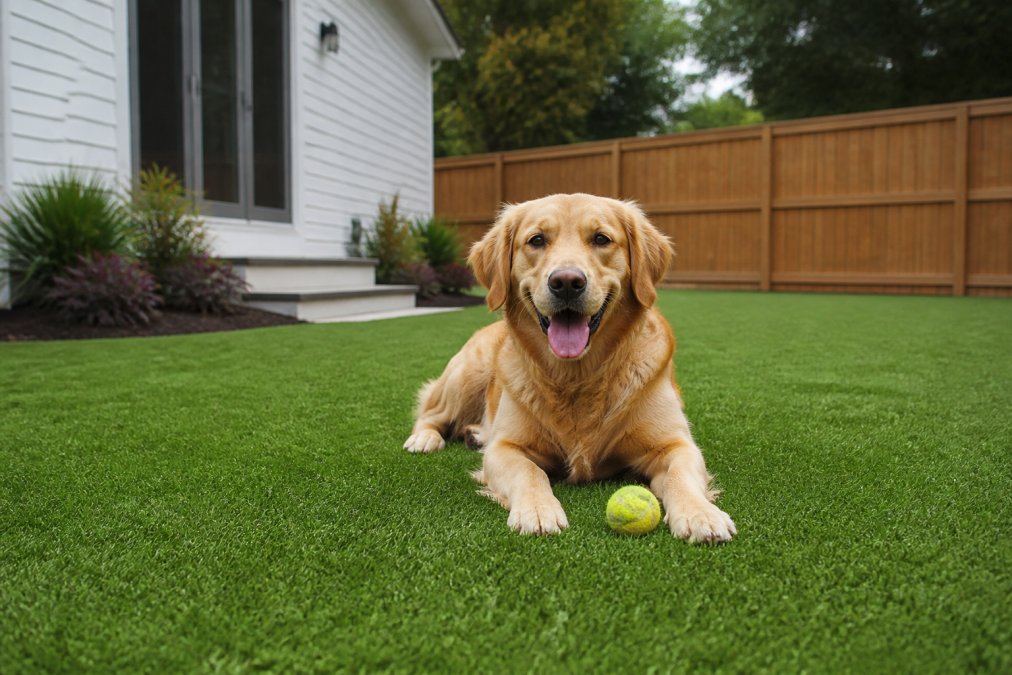
The question of is artificial turf safe for dogs has a short answer: yes, when the product is manufactured without lead, heavy metals, and PFAS, and when it is installed over a proper drainage base. This guide from Bold Turf Co. covers what actually determines safety: material composition, base construction, heat behavior, and sanitation.
PFAS-Free Artificial Grass Benefits for Pet Owners
PFAS-free artificial grass removes the class of fluorinated chemicals that some older turf products used for stain and water resistance. For households with dogs, that matters because pets have direct, repeated skin contact with the surface and often chew or lick it.
The practical benefits of choosing PFAS-free turf:
- No chemical leaching concern from fluorinated coatings into soil or runoff
- Lead-free pigments instead of older heavy-metal colorants
- Antimicrobial options that manage bacteria without relying on leaching chemistry
- UV stability so the surface does not break down and shed fibers as it ages
How to Clean Dog Urine from Artificial Turf
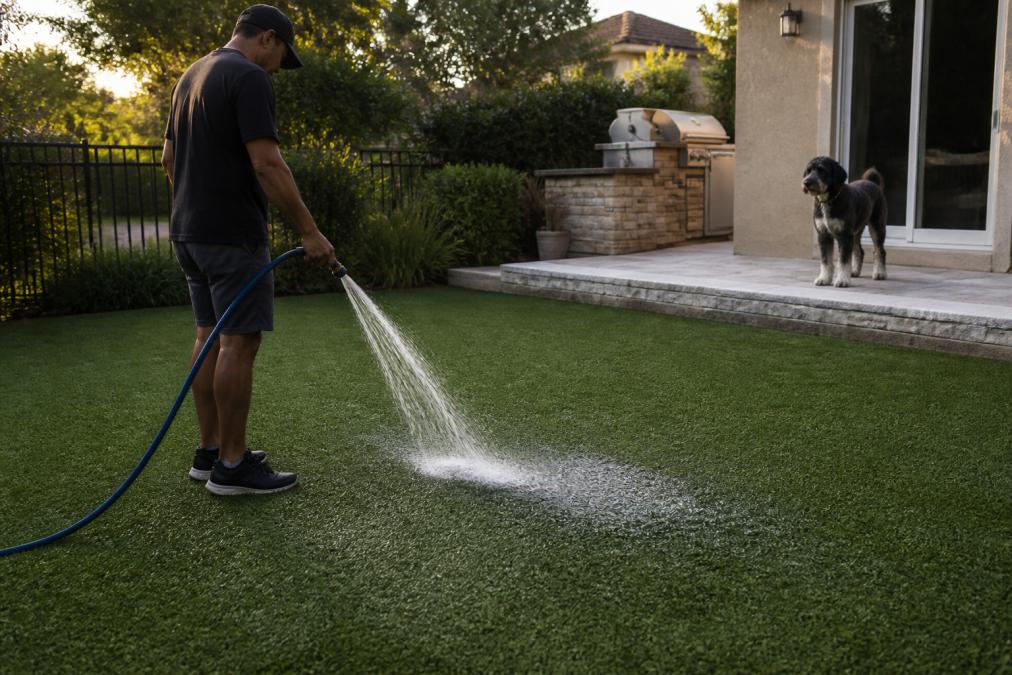
Cleaning dog urine from artificial turf is a dilution-and-flush problem, not a surface-rinsing problem. Urine is roughly 95% water, but the remaining urea, uric acid, creatinine, and salts are what concentrate in the infill and base as the water evaporates. Urea breaks down into ammonia, and ammonia is what you smell. Once ammonia has saturated the infill, no amount of surface spray will fix it, you have to move water through the profile.
Why drainage, not product, decides odor
A correctly built pet lawn has three layers that matter for urine: the backing (perforated or non-perforated), the infill (silica sand, coated sand, or an antimicrobial product), and the base (compacted crushed rock graded to a drain). Water and urine move down through the perforations, through the infill, and into the base, where they either drain away or sit. If the base is flat, poorly compacted, or lacks a drain, urine pools under the surface and wicks back up.
A maintenance schedule that actually resets the surface
| Frequency | Task | Why it works |
|---|---|---|
| Same day | Flood the soiled spot with 1-2 gallons of water per square foot | Dilutes urea before it converts to ammonia |
| Weekly | Deep-rinse the full lawn (roughly 1 inch of water across the surface) and brush against the pile | Pushes residue past the infill into the base and lifts matted blades |
| Monthly | Apply an enzyme-based pet odor treatment designed for synthetic turf | Enzymes break down uric acid crystals that water alone leaves behind |
| Quarterly | Deep clean with a mild pH-neutral cleaner and a stiff broom, then flush | Resets the infill and removes biofilm |
| Annually | Top-dress with fresh infill in the heaviest-use zones | Replaces infill that has compacted or been rinsed away |
Water volume matters more than product choice. A quick spray wets the blades; a thorough soak flushes the profile. If you have multiple dogs, plan on the weekly deep rinse being non-negotiable, two large dogs can deposit enough urine in a week to overwhelm a small lawn's drainage capacity.
What not to use
Avoid bleach, ammonia-based cleaners, and harsh detergents. Bleach degrades the backing and can discolor blades; ammonia-based products add to the exact problem you are trying to solve; and detergent residue left in the infill attracts dirt and can irritate paws. A pH-neutral cleaner or an enzyme product formulated for synthetic turf is the safer choice.
When to call it a base problem
If odor returns within 48 hours of a deep clean, or if you see standing water after rain, the issue is almost certainly the base layer or drainage slope, not the cleaning routine. At that point the fix is excavation and re-grading, not more product. This is the part most guides skip entirely, and it is the difference between a lawn that stays fresh for a decade and one that smells by year two.
Artificial Turf Heat Management for Pets
Artificial turf gets hotter than natural grass in direct sun, and surface temperature is the most underrated safety issue for dogs. Paw safety depends on surface temperature, not air temperature.
Practical temperature regulation techniques:
- Rinse the lawn with cool water before peak afternoon play
- Choose lighter-colored blades where heat retention is a concern
- Add shade structures over the main play zone
- Schedule heavy activity for morning and evening
Durability and Wear: Will Your Dog Destroy the Turf?
Durability comes down to tuft bind and pile height, not blade thickness alone. Tuft bind is how firmly each blade is anchored to the backing, and it is the number that predicts whether digging and sprinting will pull fibers loose.
What holds up best with dogs:
- Higher tuft bind resists pull-out from digging and sharp turns
- Shorter pile height in high-traffic zones reduces matting
- Strong backing material prevents seam separation
- Quality infill cushions impact and keeps blades upright
Allergies, Bacteria, and the Microbiome: What Pet Owners Should Know
This is the part most turf articles skip. Synthetic grass does not host the same soil microbiome as natural grass, and that single fact changes how waste, bacteria, and allergens behave on the surface. Understanding it is what separates a lawn that stays hygienic for years from one that becomes a persistent problem.
Why the microbiome matters
Natural grass sits on living soil. Bacteria, fungi, and invertebrates in that soil break down pet waste continuously, and sunlight and air exposure finish the job. Synthetic turf has no soil food web. The infill, usually silica sand or a coated sand product, is inert. That means waste does not decompose on its own; it accumulates until water, cleaning, or an antimicrobial agent removes it.
Bacterial buildup: the mechanism
Warm, damp infill is a favorable environment for bacterial growth. When urine and feces residue are not flushed through the profile, organic matter stays in the top inch of infill, where summer heat and residual moisture create conditions bacteria thrive in. The result is not just odor, it is a surface that can harbor pathogens like E. coli and Salmonella, which matter for households with puppies, senior dogs, or immunocompromised pets.
Contact dermatitis and material sensitivities
Some dogs develop skin irritation from repeated contact with synthetic materials. The common triggers are:
- Residual cleaning product left in the infill after a treatment
- Damp backing that stays wet against the belly and paws
- Chemical coatings on lower-grade blades or backings
- Dyes or pigments in colored infill products
Managing the surface long term
A few habits keep the microbiome problem in check:
- Pick up solid waste immediately. Feces left on the surface is the largest single contributor to bacterial load.
- Flush the profile weekly. Water volume, not product, is what moves organic matter out of the infill.
- Let the surface dry. Persistent moisture is what bacteria need. Good drainage and sun exposure are your allies.
- Refresh infill annually in high-traffic zones so the top layer does not become compacted and anaerobic.
- Choose antimicrobial infill only as a supplement, not a substitute for the routine above.
If a dog has recurring paw or belly irritation that clears up away from the lawn, the turf is worth investigating, but the fix is usually better rinsing and a PFAS-free, lead-free product, not abandoning the surface altogether.
Installation Standards and Base Layers That Protect Your Dog
Installation quality determines long-term safety more than any single product spec. The base layer is what makes drainage, odor control, and surface stability possible.
A correct build includes:
- Excavation to proper depth for the base
- Compacted base rock substrate, graded for drainage
- A drainage system that moves water away from the play area
- Weed barrier to prevent growth through the surface
- Correct seam placement away from high-traffic zones
Conclusion: Making the Right Choice for Your Dog
Choosing pet-safe turf means verifying material composition, confirming proper drainage design, and committing to a cleaning routine. The product matters, but the installation and maintenance schedule matter just as much.
Frequently Asked Questions
Can dogs pee and poop on artificial grass?
Yes, dogs can use artificial grass for bathroom breaks. The key is proper drainage and regular cleaning. Most pet-friendly turf has a porous backing and infill that allows urine to drain through. Solid waste should be picked up immediately. Rinse the area with water weekly and use a pet-safe enzymatic cleaner monthly to prevent ammonia buildup and odors. With the right maintenance schedule, artificial turf stays sanitary for dogs.
Does artificial turf get too hot for dog paws?
Surface temperature depends on sun exposure, turf color, and infill type. On a 90°F day, artificial turf can reach 140°F or higher in direct sun. Dogs with sensitive paws can burn. Choose lighter-colored turf, add a cooling infill like silica sand, or provide shade. You can also hose down the turf before letting your dog out. Test the surface with your hand before sending your dog onto it.
How long does artificial turf last with dogs?
Quality artificial turf with dogs typically lasts 10 to 15 years. Durability depends on pile height, tuft bind, and backing material. Turf with a higher face weight and strong backing resists digging and wear better. Proper installation over a compacted base rock substrate also extends lifespan. If your dog is a digger, consider a reinforced turf or training to redirect the behavior. Regular brushing helps maintain resilience.
What are the potential health risks of artificial turf for dogs?
The main concerns are chemical leaching, heat retention, and bacterial buildup. Look for turf that is PFAS-free, lead-free, and heavy metal compliant. Older or cheap turf may contain these substances. Heat retention can cause paw burns. Bacteria and ammonia from urine can irritate paws or cause contact dermatitis if not cleaned. Choosing non-toxic materials and following a sanitization routine reduces these risks significantly.