 how-to
Drainage Solutions for Artificial Turf Lawns That Work
Table of Contents
- Why Artificial Turf Drainage Fails: A Diagnostic Guide
- How Water Moves Through Turf Backing and Perforations
- Artificial Grass Base Preparation: The Layer That Decides Everything
- Standing Water on Artificial Turf: Causes and Fixes
- Drainage for Artificial Grass on Concrete and Hard Surfaces
- Perforated Drainage Pipe, Ag-Pipe, and Drainage Grids
- Pet Turf Drainage and Odor Control
- Retrofitting an Existing Lawn and When to Call a Pro
- Frequently Asked Questions
Last Updated: October 17, 2026
Why Artificial Turf Drainage Fails: A Diagnostic Guide
Water that pools on artificial turf almost always traces back to one of four problems: a clogged surface, a compacted sub-base, missing or crushed drainage stone, or a yard that slopes the wrong way. At Bold Turf Co., we see drainage solutions for artificial turf lawns fail for boring reasons far more often than exotic ones.
Turf itself rarely causes the flooding, the carpet is the messenger. Water sits on top because something underneath stopped accepting it. Diagnose before you buy.
Symptom-to-Cause Checklist
Use this table to match what you see with what is likely wrong. Fix the cause, not the puddle.
| Symptom | Likely Cause | First Fix to Try |
|---|---|---|
| Water beads on top, never soaks in | Clogged perforations or matted pile | Power-broom the fibers, clear debris |
| Puddles in one low spot only | Low point in grading or settled base | Lift and re-grade that area |
| Water spreads across whole lawn | Compacted sub-base or missing aggregate | Aerate or rebuild base layer |
| Pooling at edges against a wall | No outlet or blocked pipe | Clear outlet, add drainage channel |
| Soggy spots where pets go | Organic waste sealing the backing | Rinse, enzyme treat, improve flow |
| Flooding after every heavy rain | Undersized drainage capacity | Add ag-pipe or drainage grid |
How Water Moves Through Turf Backing and Perforations
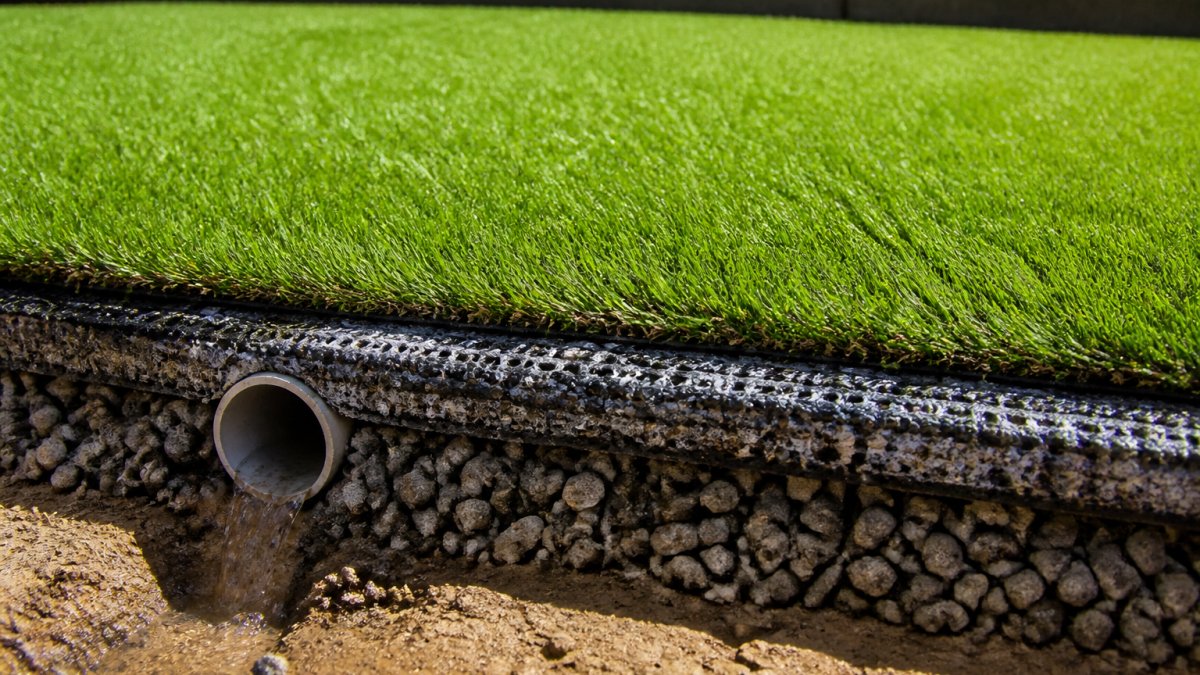
Water leaves an artificial lawn through two paths: down through the turf backing and perforations, then out through the base layers.
Perforations are the small holes punched through the backing that let water pass into the base.
Water permeability measures how fast water passes through. Quality turf allows steady flow; a clogged one acts like a tarp.
The backing matters too.
Artificial Grass Base Preparation: The Layer That Decides Everything
The base is where drainage is won or lost. A perfect carpet over a bad base will flood. A modest carpet over a good base will drain for years.
Good artificial grass base preparation means three things: the right material, the right depth, and proper compaction.
Sub-Base Materials, Depth, and Compaction
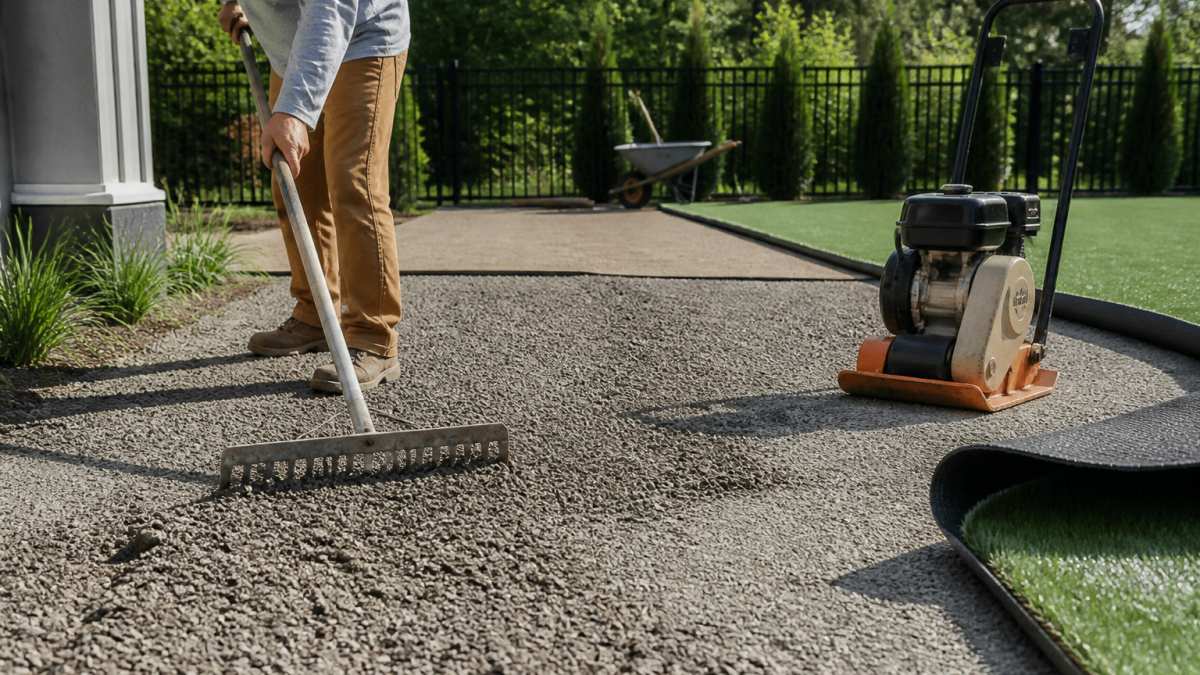
The sub-base is the excavated, graded, and compacted layer beneath the turf. It carries the load and moves the water.
- Crushed aggregate (angular gravel) is the standard choice. It compacts well and drains fast.
- Depth typically runs a few inches, deeper for high-traffic or pet areas.
- Compaction must be done in lifts, not all at once. Loose gravel shifts and settles, creating low spots.
A common mistake is skipping the fabric. Without it, fine soil migrates into the gravel and clogs it.
Grading and Slope for Runoff
Grading is the shape you build into the base so water flows toward an outlet. Flat is not your friend.
The base should slope gently away from structures and toward a drain, swale, or yard edge. Without slope, water sits where it lands.
Compacted soil underneath must also drain. If the native subgrade is heavy clay, the whole system backs up, plan for an outlet rather than relying on infiltration.
Standing Water on Artificial Turf: Causes and Fixes
Standing water on artificial turf is water that cannot leave fast enough, either too much coming in or too little going out.
Start with the cheap checks:
- Clear the surface. Remove leaves, dirt, and debris blocking the perforations.
- Brush the fibers upright. A stiff broom or power broom opens the pile so water can pass.
- Check the outlet. If you have a drain or pipe, make sure it is not blocked.
- Test the base. Press down. Spongy ground means the aggregate is saturated or compacted.
If those do not solve it, the problem is in the base: lift the turf, restore the aggregate, and re-grade. It is the only real fix.
Drainage for Artificial Grass on Concrete and Hard Surfaces
Drainage for artificial grass on concrete needs a different approach because water cannot soak into the ground beneath. It has to run off.
On a patio, rooftop, or balcony, the surface must slope toward a drain or edge; water that cannot escape pools against the turf edge and seeps under it.
Options that work on hard surfaces:
- Drainage tiles or a drainage grid laid over the concrete to create a gap for water
- Open-cell material under the turf to hold and channel water to an outlet
- Perimeter drainage channels to catch runoff at the edges
The key is giving water a path off the slab. Without an outlet, no underlayment will save you.
Perforated Drainage Pipe, Ag-Pipe, and Drainage Grids
When grading alone cannot move water fast enough, you add hardware.
Perforated drainage pipe (ag-pipe) is a flexible, corrugated pipe with holes that collects water from the surrounding gravel and carries it to an outlet. It is buried in gravel trenches cut into the base. Two details decide whether it works:
- Slope. The pipe must fall continuously toward the outlet. A common target is about a 1% grade, roughly 1/8 inch of drop per foot of run, so a 40-foot run drops about 5 inches end to end. Flat or back-sloped pipe holds water and silts up.
- Trench and surround. Set the pipe in a trench lined and topped with washed, angular gravel, not rounded river rock, which shifts and packs. Keep the perforations facing down or to the sides so water enters rather than soil.
- Sock or fabric. A fabric sock over the pipe, or geotextile wrapping the trench, keeps fines out of the holes. Skip it and the pipe perforations clog within a season or two.
Drainage grids are modular panels, often called drainage tiles or open-cell systems, that create a void under the turf for water to travel sideways to an outlet.
A quick comparison:
| Tool | Best For | Where It Goes | Sizing Note |
|---|---|---|---|
| Ag-pipe | Moving collected water to an outlet | Buried in gravel trenches | Match diameter to drained area; keep continuous fall to outlet |
| Drainage grid | Flat or hard-surface installs | Under the turf, over the slab | Deeper cells for larger contributing areas |
| Drainage mesh | Filtering and separating layers | Between aggregate and soil | Cover the full trench and overlap seams |
Pipe sizing and outlet placement. There is no universal pipe diameter; capacity depends on the area draining to it, the rainfall intensity you design for, and the fall available.
If you are unsure how to size pipe or place an outlet for your lot, bring in a professional rather than guess.
Pet Turf Drainage and Odor Control
Pet turf drainage and odor control are the same problem wearing two hats. Waste that sits in the base creates both the smell and the slowdown.
When pets use a lawn, urine soaks through the perforations into the aggregate. If the base drains well, it rinses through; if not, waste collects, bacteria grow, and odor sticks around even after rain.
What actually helps:
- Fast-draining base with proper aggregate and slope
- Regular rinsing to flush waste through the perforations
- Enzyme cleaners made for artificial turf to break down waste
Retrofitting an Existing Lawn and When to Call a Pro
If your lawn is already installed and flooding, you have two paths: patch the surface or rebuild the base. Here is the actual sequence for fixing an existing lawn, so you can judge whether to tackle it or hand it off.
Step 1: Rule out the cheap fixes first
Before lifting anything, clear debris, power-broom the pile upright, flush the perforations with a hose, and confirm the outlet is open. If water still pools after a heavy rain, the problem is in the base and you move to Step 2.
Step 2: Map the problem before you cut
Walk the lawn after rain and mark every low spot, every seam, and where water exits (or should). Note where the turf meets walls, edging, and hard surfaces. This map tells you how much turf to lift and where new drains need to go.
Step 3: Lift the turf without wrecking it
- Cut along seams, not across the field. Separate sections at existing seams so you can relay them in the same orientation.
- Roll, don't drag. Peel back and roll each section pile-up, keeping the backing clean.
- Label sections. Mark which piece came from where so infill and grain direction go back correctly.
Step 4: Correct the base
With the turf up, you can see the real cause:
- Compacted or missing aggregate, scarify or remove and rebuild in lifts, compacting each lift before the next.
- Wrong-way slope, re-grade the base so it falls continuously toward the outlet, typically a gentle grade of about 1% to 2% away from structures.
- Clogged stone, if fines have silted the aggregate, replace the fouled layer and add geotextile fabric between subgrade and stone.
Step 5: Relay and re-seam
Lay sections back in the same orientation, pull seams tight, and re-secure them with the same seam tape or adhesive method used originally. Re-spread infill, brush it in, and water lightly to settle. Check the surface for new low spots after the first rain and adjust.
DIY or professional?
| Situation | Realistic Path |
|---|---|
| One small low spot, outlet clear | DIY patch, lift a section, re-grade, relay |
| Widespread pooling, base intact | Pro recommended, re-grading and re-compaction |
| Base rebuild or new ag-pipe/outlet | Pro, excavation, drainage design, and code compliance |
| Hard-surface or rooftop install | Pro, outlet and structural constraints |
| Pet odor persists after cleaning | Pro, base may need replacement, not just rinsing |
When to call a professional: water pools across large areas rather than one spot; the base needs rebuilding or the yard needs re-grading; you need ag-pipe or a new outlet; the lawn sits on concrete or a hard surface; or pet odor persists after cleaning.
At Bold Turf Co., we handle drainage solutions for artificial turf lawns from diagnosis through installation, using PFAS-free materials and managing each project start to finish. Our team is local and family-owned, so you deal with the owners, not a call center.
Frequently Asked Questions
Does artificial grass need a drain?
Not always, but it needs a path for water to leave. Turf backing with drainage perforations lets rain pass into the base layer, so on well-draining soil a properly graded gravel sub-base often handles runoff without a pipe. You need added artificial turf drainage when the soil is compacted clay, the site is flat or low-lying, or the turf sits over concrete. In those cases a perforated pipe, drainage grid, or open-cell pad carries water to an outlet instead of letting it pool.
Why is standing water on artificial turf after heavy rain?
Standing water on artificial turf usually traces to one of four causes: a base that was not compacted or graded, a sub-base of fines that clogs and stops soil infiltration, a low spot with no outlet, or a non-perforated backing that blocks water permeability. Check for debris blockage on the surface first, then probe the low spot to see whether water sits on the backing or in the base. Fixing grading and adding an outlet solves most cases; a clogged base layer may require lifting and relaying turf.
Can you add drainage to an existing artificial turf lawn?
Yes. The common retrofit is to lift and relay turf: cut the lawn into manageable sections, roll it back, excavate a trench to the correct slope, lay geotextile fabric, install perforated drainage pipe in gravel, then reinstate the base and turf. Smaller fixes include aerating perforations, clearing debris, and adding a surface drain at the lowest point. Plan the work for dry weather and keep cut edges aligned so seams stay tight when the turf goes back down.
How do you control pet odor and soggy spots on pet turf?
Pet turf drainage and odor control work together. Install an open-cell or perforated backing over a free-draining base so urine moves down and away, then rinse the area with water and use an enzyme-based cleaner made for synthetic turf. Odor builds where waste sits in standing water, so fixing pooling solves most smell complaints. For homes with multiple dogs, a slightly deeper gravel base and a drainage grid under high-traffic zones reduce saturation and keep the surface quick drying.
Flooding on artificial turf is almost always a base problem, not a turf problem. The good news is that it is fixable, and the fix lasts when it is done correctly. Bold Turf Co. brings local, owner-led project management, PFAS-free materials, and 0% financing options to every job, so you get a lawn that drains and stays dry. Get started with Bold Turf Co. and request your free turf estimate today.