 How-to
Is Artificial Grass Safe for Children to Play On?
Last Updated: November 7, 2026
Quick Summary
Safe artificial grass for children is turf made with lead-free, PFAS-free materials that passes independent safety testing and sits on a base built for impact absorption. Safety depends on what the turf is made of, how it drains, how much force it absorbs in a fall, and how hot it gets in the sun. Ask for third-party test reports rather than marketing claims.
- Verify third-party lab results for lead, heavy metals, and PFAS on the specific product you buy.
- Choose polyethylene fibers, a polypropylene backing, and no crumb rubber infill for play areas.
- Rate the whole system: turf, pad, and base together determine fall protection, not turf alone.
- Extend the protective surface well beyond equipment, following the manufacturer's recommended use zone.
- Rinse the surface weekly in hot months to cool it and lift dust.
Table of Contents
- What Makes Artificial Grass Safe for Children Play Areas
- Certifications and Test Results to Verify
- How to Choose Non-Toxic Artificial Grass for Kids
- Picking the Best Artificial Turf for Playground Use
- Shock-Absorbing Playground Turf Underlayment and Fall Protection
- Heat, Drainage, and Environmental Trade-Offs
- Installing Artificial Grass for a Backyard Play Area
- Artificial Grass Maintenance for Play Areas
- Get a Free Turf Estimate for Your Play Area
- Frequently Asked Questions
What Makes Artificial Grass Safe for Children Play Areas
Safe artificial grass for children play is turf that uses lead-free, PFAS-free materials, passes independent safety testing, and sits on a base built for impact absorption.
At Bold Turf Co., we install PFAS-free turf across Northeast Florida, and parents often ask whether turf is actually safe for their kids. The honest answer is that safety is a specification, not a slogan. Two rolls of turf can look identical and perform very differently under a child's feet.
Below, we'll show you exactly what to check before you buy, from certifications to installation, so you can judge any turf on facts rather than marketing claims.
Certifications and Test Results to Verify
Ask for the test report, not the brochure. A supplier claiming "child-safe" turf should be able to produce third-party lab results for lead content, heavy metals, and PFAS on the specific product you're buying.
The two things worth verifying:
- Lead and heavy metals testing. Older or imported turf has occasionally contained lead in pigments and stabilizers. Reputable manufacturers test finished turf, not just raw materials.
- PFAS testing. PFAS are fluorinated compounds used in some stain and water repellents. Ask whether the backing, fibers, and coatings are all PFAS-free, since a claim can cover only one component.
For a deeper look at why PFAS-free construction matters for families, see our guide to benefits of PFAS-free artificial grass. A supplier who hesitates on documentation is telling you something.
Consumer Product Safety Commission guidance on lead in consumer products
How to Choose Non-Toxic Artificial Grass for Kids
Start with the material list. Non-toxic artificial grass for kids is generally built with polyethylene fibers, a polypropylene backing, and no crumb rubber infill. Those three choices address the most common chemical concerns.
Polyethylene is a common fiber for play turf because it's soft and colorfast, and polypropylene backings are a common choice for drainage. Where families get into trouble is infill: crumb rubber from recycled tires is cheap and effective for sports fields, but many parents prefer to avoid it in a backyard where toddlers crawl.
If you want infill at all, look at coated sand, cork, or antimicrobial options.
A common mistake is assuming "natural-looking" means "natural materials." It doesn't. Judge the turf by its spec sheet.
Picking the Best Artificial Turf for Playground Use
The best artificial turf for playground use balances softness, durability, and drainage. For most backyard play areas, shorter pile heights and a perforated backing that lets water through are commonly recommended.
Pile Height, Fiber Density, and Backing
Pile height is how tall the fibers stand. Longer pile looks plusher but mats down under foot traffic and holds debris. For play areas, shorter pile wins: it stays upright, cleans easier, and gives a firmer, more predictable surface for running and games.
Fiber density is how tightly the fibers are tufted. Denser turf resists wear in high-traffic zones like the base of a swing set or the bottom of a slide. Backing matters just as much: a perforated, multi-layer backing drains faster and resists mold in humid climates.
If you want to see the specs available for family yards, review our residential artificial turf installation options before you compare samples.
Shock-Absorbing Playground Turf Underlayment and Fall Protection
Fall protection is where safety gets measurable. Shock-absorbing playground turf underlayment is a foam or rubber pad installed beneath the turf that reduces impact force when a child falls. The key number is critical fall height: the maximum drop height the surface is rated to protect against. Get this number wrong and the turf can feel soft while still failing under a real fall.
How Fall Height Is Measured
Critical fall height is established by impact testing, not by feel. The common laboratory method drops a weighted missile onto a sample of the complete surfacing system and measures deceleration; the highest drop that stays within the test threshold becomes the rated fall height. In the field, installers verify the same property with a portable impact tester at multiple points across the play zone. What matters for your yard is that the rating applies to the whole assembly, turf, pad, and base together, because a pad rated on its own can perform differently once turf and infill sit on top of it.
Matching the System to Your Equipment
Fall height is measured from the highest designated standing surface of the equipment, not from the top of a roof or a decorative peak. A 4-foot play structure and a 7-foot climbing frame need different underlayment thicknesses, and the required thickness depends on the pad's published rating, not on a rule of thumb. Most practitioners find that a single pad thickness rarely covers a yard with mixed equipment, so the play zone is often split: a thicker pad under the swing set and climbing frame, a thinner one under lower platforms and the surrounding use zone.
Two rules to follow on any play install:
- Rate the whole system. Turf plus pad plus base together determine fall protection, not the turf alone. Ask for the impact test report for the specific pad-and-turf combination, not a generic pad datasheet.
- Keep the fall zone clear. The protective surface should extend well beyond the equipment, following the manufacturer's recommended use zone. A pad that stops at the legs of a swing set leaves the landing area unprotected.
What Documentation to Request
Ask your installer for the impact test documentation for the specific pad and turf combination, the pad's published critical fall height rating, and field test results from the installation. A rating for the pad in isolation does not show that the installed system meets your equipment's fall height. For a deeper look at how the base and drainage layers interact with the pad, see our guide to drainage solutions for artificial turf lawns.
Heat, Drainage, and Environmental Trade-Offs
Surface temperature is the trade-off nobody likes to discuss. Synthetic turf gets hotter than natural grass in direct sun, and in a Florida summer that difference is noticeable. Shade, lighter turf colors, and a quick hose-down before play all reduce surface temperature.
Drainage is the second trade-off. Turf sheds water through its backing, but only if the base beneath it is graded and permeable. Poor drainage leads to standing water, slippery patches, and mold.
On the environmental side, older turf can shed microplastics as fibers wear. Choosing quality fibers, avoiding loose crumb infill, and planning for end-of-life recycling all reduce that impact. No surface is impact-free; the goal is a well-built one.
EPA information on PFAS and consumer product safety
Installing Artificial Grass for a Backyard Play Area
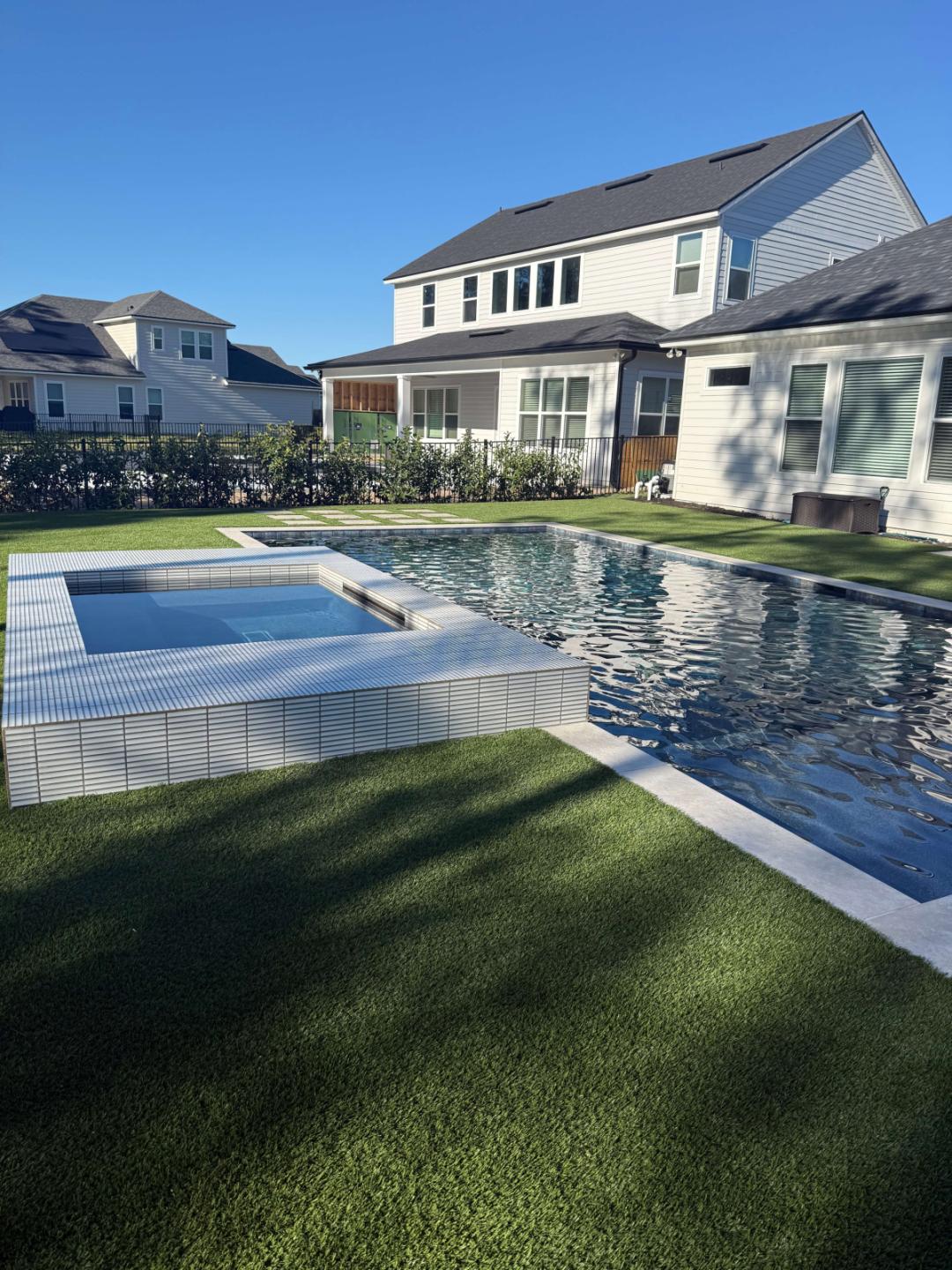
Proper installation decides whether the turf stays safe and flat for years. The work generally happens under the surface: excavate, grade for drainage, compact a base, add a shock pad, then seam and secure the turf. A play area adds one requirement a plain lawn does not, the base and pad must be flat and consistent enough that fall protection performs the same everywhere a child might land.
Site Preparation and Base
- Remove existing grass and soil to the required depth. The depth is set by the base layer, the shock pad, and the turf pile together, so confirm the pad thickness before you dig.
- Grade the subgrade so water runs away from the play zone, with a consistent slope toward the drainage outlet rather than a flat pan that traps water.
- Compact a crushed stone base in lifts and check it for flatness with a straightedge. Low spots under a shock pad become soft spots under a child's foot.
- Install and secure the shock-absorbing pad, keeping seams tight and the pad continuous across the full use zone.
Turf, Seams, and Edging
- Roll out turf, let it relax, then seam the panels and trim to the edging. Seams belong away from high-traffic landing zones where they can lift.
- Secure the perimeter with edging or a nailed-down border, then power-broom the fibers upright.
Infill and Post-Installation Checks
If the install uses infill, apply it in passes and brush it in so the pile stands evenly; many play installs use no loose infill and rely on a dense, short pile instead. After installation, walk the full play zone and check for ripples, raised seams, and low spots, then confirm the surface drains by running water across it. Ask for the field impact test results before the equipment is used.
Artificial Grass Maintenance for Play Areas
Maintenance for play turf is simple but not zero. Rinse the surface periodically, remove debris, and brush the pile to keep fibers upright. In pet households, a mild enzyme cleaner handles odors.
A practical schedule:
| Task | Frequency | Why It Matters |
|---|---|---|
| Rinse with water | Weekly in hot months | Cools surface, lifts dust |
| Remove leaves and toys | Weekly | Prevents matting and staining |
| Brush pile upright | Monthly | Restores softness and look |
| Deep clean with mild soap | 2-3 times a year | Sanitation and odor control |
| Inspect seams and edges | Seasonally | Catches lifting before trips |
For a fuller seasonal routine, our artificial turf maintenance guide covers heat, storms, and pet care in detail. Sanitation matters most where toddlers play, so don't skip the periodic deep clean.
Get a Free Turf Estimate for Your Play Area
Before you commit, get real numbers for your yard size and equipment layout. Installed pricing depends on square footage, base work, pad thickness, and site access, so a written estimate beats any online guess.
If you want to see how cost scales by yard size first, review our artificial turf cost breakdown for backyard projects. Then request a free estimate from Bold Turf Co. for current pricing and a quote.
Every play area comes down to the same decision: build it to a spec, or hope the turf is "safe enough." If you want a surface your kids can fall on, run on, and grow up on without second-guessing it, Bold Turf Co. installs PFAS-free turf with proper shock-absorbing underlayment, drainage built for local soil, and owner-led project management from start to finish.
Frequently Asked Questions
What is the safest artificial grass for a playground?
Look for turf that carries independent safety testing and is labeled lead-free and PFAS-free, with no crumb rubber infill. The safest setups pair a certified play surface with a shock-absorbing underlayment sized to your equipment's critical fall height. Ask the installer for test reports before you buy.
Does artificial grass need a shock-absorbing layer under play equipment?
Yes, if you have swings, slides, or climbing frames. Turf alone does not absorb falls the way a dedicated pad does. A shock-absorbing playground turf underlayment, often a foam or rubber pad, is installed under the turf and sized to the critical fall height of each structure. For flat play areas with no equipment, a standard base is usually enough.
Can artificial grass get too hot for children to play on?
Surface temperature can climb well above air temperature in direct sun, especially on darker turf. Choose a lighter color, add shade, and check the surface with your hand before play on hot days. Watering the turf briefly cools it down. In Northeast Florida, afternoon shade and lighter turf colors make a real difference for bare feet.
How do you keep artificial grass clean and safe for children?
Rinse the turf periodically, remove debris and pet waste promptly, and brush the fibers to keep them upright. Use an antimicrobial infill if pets share the space. Avoid harsh chemicals; mild soap and water are usually enough. A simple monthly routine keeps the surface sanitary and extends its life.